
Biscuit joinery is a woodworking method that joins two pieces of wood using small oval discs called biscuits, wood glue, and matching slots cut into each board. The biscuit sits inside both slots at once and swells slightly as the glue sets, pulling the two pieces into perfect alignment and locking them together.
At Craig Smith Joinery, we’ve been using biscuit joints in our workshop for over 30 years, mostly while building fitted wardrobes and storage across Nottinghamshire. In that time we’ve used biscuits on hundreds of jobs, trained apprentices to cut them properly, and learned exactly where they shine and where they fall short. This guide gives you a straight, no nonsense answer on what biscuit joinery actually is, how it works, and when it’s genuinely the right call rather than just the quickest one.
Where Biscuit Joinery Comes From
Biscuit joinery isn’t a new idea. It became popular in workshops from the 1950s onwards, once purpose built biscuit joiners made it possible to cut clean, curved slots quickly and consistently. Before that, joiners relied almost entirely on dowels, or fully hand cut joints like mortise and tenon, both of which take far longer to set up.
Biscuit joinery gave tradespeople a faster way to align and strengthen panel joints without sacrificing much in terms of holding power. It’s stuck around for decades because it solves a genuine, everyday problem: keeping two boards level and locked together while glue cures, without needing hours of careful marking out.
Over time, the tool itself has also improved. Early biscuit joiners were fairly basic, but modern versions offer adjustable fences, depth settings, and dust extraction ports that make the whole process cleaner and more precise.
That evolution is part of why biscuit joinery has remained a standard technique in workshops rather than being replaced entirely by newer methods like dominoes or pocket screws. Each has its place, but biscuits remain a dependable, well understood option for a huge range of everyday joinery tasks.
How a Biscuit Joint Actually Works
A biscuit joint connects two boards edge to edge, or at a corner, without any visible screws or nails. Here’s the process, step by step:
- A biscuit joiner cuts a small, curved slot into each piece of wood that needs joining. The tool has a small spinning blade that plunges into the wood at a set depth, cutting a slot slightly bigger than the biscuit itself.
- The oval shaped biscuit, made from compressed wood (usually beech), gets a coat of wood glue on both faces.
- The biscuit goes into one slot, and the second board is pressed onto it so the biscuit sits inside both slots at the same time, straddling the joint line.
- The glue swells the biscuit, filling the slot tightly and holding everything in place while it dries. This swelling is part of what makes the joint strong; the biscuit physically grips the inside of the slot as it expands.
Done properly, you get a strong, hidden joint with a completely flat surface. From the outside, nobody can tell a biscuit joint is there at all, which is exactly the point. There are no visible fixings, no filled screw holes, and no interruption to the grain, which is one of the main reasons biscuit joints are so widely used in furniture and cabinetry where appearance matters as much as strength.
It’s also worth understanding why the swelling action matters so much. As the biscuit absorbs moisture from the glue, it expands slightly within the slot, creating gentle internal pressure that helps draw the joint tight and resist minor movement while the adhesive fully cures. This is different from a dry mechanical fixing, since the strength builds gradually as the glue sets rather than being fixed the moment the pieces are pressed together.
Why We Reach for Biscuits on Fitted Storage Work
After three decades of building fitted wardrobes and storage, biscuit joinery earns its place in our workshop for three main reasons:
- Alignment. The biscuit keeps panels perfectly level while the glue cures, which matters a lot on wardrobe carcasses where doors need to sit flush against each other. Even a couple of millimetres out and you’ll see it in the gap between doors.
- Strength. A glued biscuit joint holds noticeably better than a plain glued edge on its own, because the biscuit adds a mechanical connection as well as a glued surface.
- Speed. Cutting biscuit slots is faster than cutting a full mortise and tenon, which keeps labour time, and cost, down on large fitted units where there might be a dozen or more panel joints in a single wardrobe.
There’s also a practical workshop reason we like biscuits for fitted storage specifically: most wardrobe and cabinet panels are flat, wide boards being joined edge to edge or at right angles, which is exactly the kind of joint biscuits were designed for. It’s a good match between the tool and the job, rather than using biscuits just because they’re familiar.
On top of that, biscuit joints are forgiving to work with under real workshop conditions. When you’re assembling a full wardrobe carcass with multiple panels needing to come together at roughly the same time, a joint that helps self align as you clamp up makes the whole glue up process calmer and less rushed. That matters more than people often expect, since a stressful glue up is where mistakes creep in.
Biscuit Joints vs Other Joining Methods
| Joint Type | Best For | Strength | Skill Needed | Speed |
| Biscuit joint | Wardrobe panels, cabinet sides, tabletops | Good | Low to Medium | Fast |
| Dowel joint | Cabinet carcasses, shelving | Good | Medium | Medium |
| Pocket hole joint | Face frames, quick assembly | Moderate | Low | Fast |
| Mortise and tenon | Frames, doors, load bearing furniture | Excellent | High | Slow |
The short version: biscuit joints sit in the middle. They’re stronger than a bare glued edge, faster than a mortise and tenon, and ideal for flat, hidden joints on cabinet and wardrobe panels. None of these joints is universally “best.” The right choice always depends on what the piece needs to survive over its lifetime, and that’s really the whole point of this guide.
It’s also worth noting that these methods aren’t always used in isolation. Many well built pieces of furniture combine two or three joining techniques in the same build, using each one where it performs best. A wardrobe might use biscuits for the carcass panels, a stronger joint for the door frames, and screws or brackets for fixing it to the wall. Good joinery is about choosing the right combination, not picking one method and forcing it to do every job.
Where Biscuit Joinery Works Best
In our experience, biscuit joints are the right tool for:
- Joining boards edge to edge to build a wider panel, such as a wardrobe side or a shelf that’s too wide for a single board
- Assembling fitted wardrobe and cabinet carcasses, where flat, aligned panels matter more than raw strength
- Lining up mitred corners on frames and boxes, where the biscuit stops the mitre sliding out of place during glue up
- Any job where a flat, seamless finish matters more than maximum load bearing strength
If you picture a wardrobe carcass, most of the joints holding it together are exactly this kind of flat panel connection, which is why biscuits show up so often in fitted storage work specifically. Shelving units, cabinet sides, tabletops built from several narrower boards, and internal wardrobe partitions all fall into this same category, which is part of why biscuit joinery has remained such a staple technique in furniture making rather than a niche one.
When We Switch to a Different Joint
Thirty years in means we know biscuits aren’t the answer to everything, and being upfront about that matters more to us than pushing one method for every job:
- Load bearing furniture like doors, drawer fronts under heavy daily use, or structural frames. We’ll use a mortise and tenon joint here, since it handles stress far better over time and won’t loosen with repeated movement.
- Very thin timber. There often isn’t enough material for a biscuit slot without weakening the wood, so a simpler glued joint or a smaller dowel might be safer.
- Anywhere the joint takes constant knocks, like a bench top edge or a heavily used drawer runner. A stronger, more traditional joint earns its keep here, even if it takes longer to make.
Knowing when not to use a technique is just as important as knowing when to use it. A joiner who reaches for the same joint on every job, regardless of what that job actually needs, isn’t saving time in the long run. They’re just moving the risk of failure further down the line, usually to whoever ends up living with the finished piece.
A Real Job from Our Workshop: Getting Alignment Right
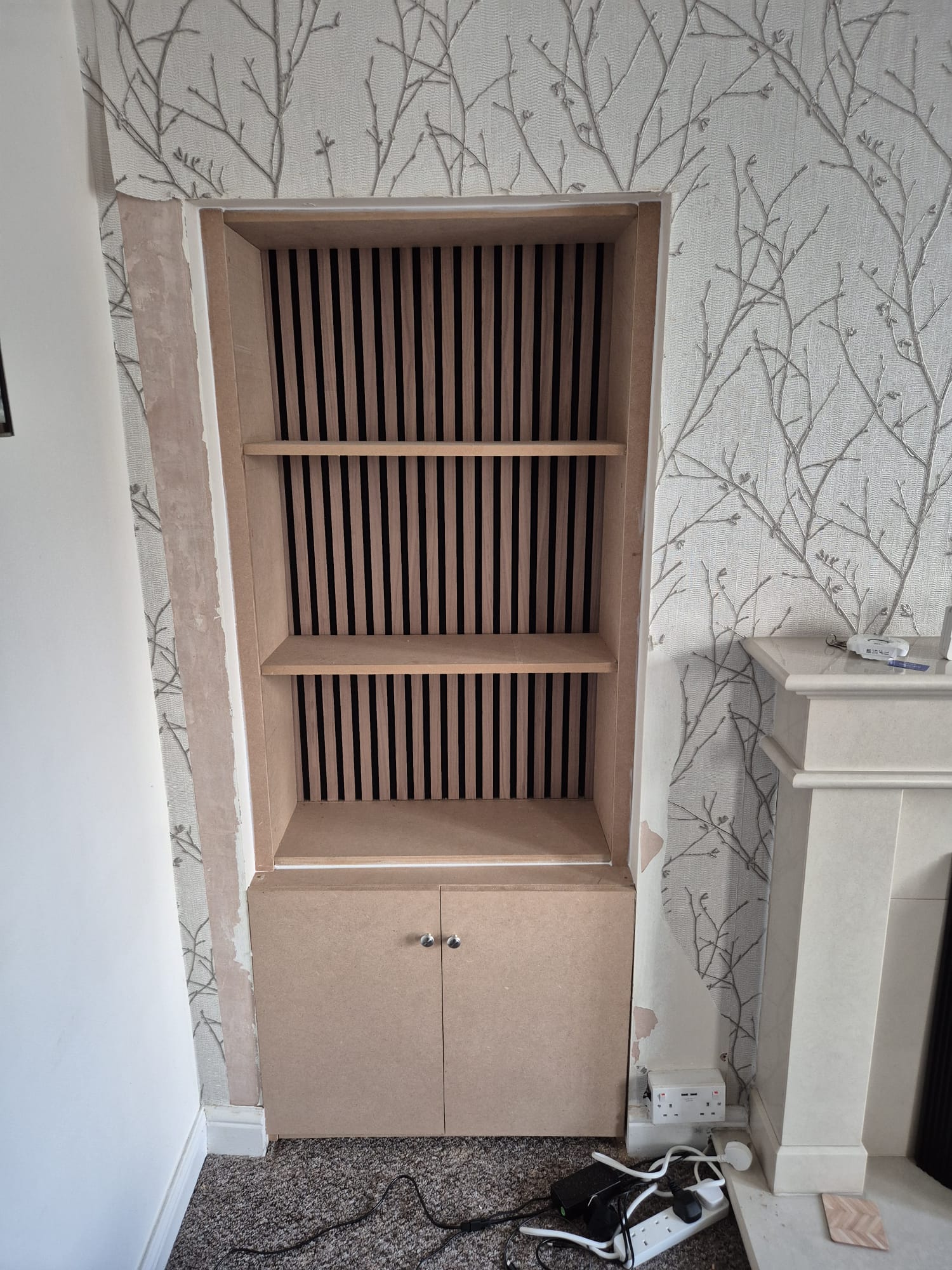
On a fitted wardrobe project here in Nottinghamshire, we used biscuit joints to assemble the internal carcass panels. Biscuits kept every panel dead level during glue up, which meant the doors and internal shelving fitted first time, with no packing or adjustment needed afterwards. That might sound like a small detail, but on a job with several carcass sections needing to line up side by side, even slight misalignment adds up fast and can throw off the whole run.
A word of caution from experience: the most common mistake we see with biscuit joinery, whether from newer joiners or rushed DIY jobs, is poor alignment from cutting the slots too quickly. If the biscuit joiner isn’t held flat and steady against the reference face, the two boards end up slightly out of line, and you notice it the moment the doors go on.
Taking an extra thirty seconds per slot to keep the tool square avoids the problem entirely. It’s a small step, but it’s the difference between a wardrobe that closes flush and one that needs constant adjusting, or worse, gets forced into place and ends up under stress at the joint.
This is really the heart of good joinery: not the joint itself, but the care taken while making it. A biscuit joint cut carelessly will always underperform a mortise and tenon cut with patience, and a biscuit joint cut properly will comfortably outlast a rushed, more “advanced” joint. The method matters less than the attention behind it.
We’ve found that this lesson tends to stick with apprentices once they’ve seen it play out on a real job. It’s one thing to be told that accuracy matters, and another to watch a wardrobe door sit slightly proud because a slot was cut a fraction off square. Once someone has fixed that problem themselves, they rarely rush the step again.
Does Biscuit Joinery Change the Cost of a Project?
Generally, biscuit joints keep costs down compared to more time intensive joints, since they’re quicker to cut and don’t need extensive hand fitting. As a general guide:
- Panels and carcasses built mainly with biscuit joints tend to have lower labour costs, since assembly is faster and there’s less setting out time involved.
- Projects that mix biscuits with stronger joints where needed, like frames or doors, sit in the middle, balancing speed with the extra strength required in specific spots.
- Fully hand cut traditional joinery throughout tends to cost more, and is usually reserved for heirloom quality pieces where the joinery itself is part of what you’re paying for.
Every project is different, so the best way to get a proper figure for your own job is a free quote based on the design, timber, and finish you have in mind. Material choice, the number of panel joints involved, and the finish you want all play into the final price, so it’s worth discussing your project in detail before assuming which joinery method will be used throughout.
Frequently Asked Questions
Is biscuit joinery strong enough for fitted wardrobes?
Yes. For wardrobe and cabinet carcasses, biscuit joints give more than enough strength, especially combined with the cabinet’s own structure and back panel. They’re not the right choice for parts under constant heavy stress, like structural door frames or anything that gets pulled or leaned on regularly.
Can biscuit joints be used outdoors?
They can, with waterproof glue and biscuits, but for outdoor furniture facing constant damp, a mortise and tenon or dowel joint holds up better long term, since biscuits can be more sensitive to repeated wetting and drying.
Do I need a special tool for biscuit joinery?
Yes, a biscuit joiner cuts the slots. It’s a specialist tool most people don’t have at home, which is one reason this kind of joinery is usually left to a professional who already owns the right equipment and knows how to set it up accurately.
Is biscuit joinery the same as dowel joinery?
No. Dowels are round pegs glued into drilled holes. Biscuits are flat oval discs glued into curved slots. Both help with alignment and strength, but the tools, technique, and typical uses are different, and each has situations where it performs better than the other.
How long does a biscuit joint take to dry?
Wood glue in a biscuit joint usually holds firmly enough to handle within 30 minutes to an hour, and reaches full strength after roughly 24 hours. It’s always worth leaving a piece fully clamped overnight before putting any real load on the joint.
Why did my biscuit joint come out uneven?
This almost always comes down to the slot cutting step. If the biscuit joiner isn’t held flat and square against the wood while cutting, the slots end up slightly misaligned, and the boards won’t sit flush. Slowing down and keeping the tool steady, and double checking your reference face before every cut, solves it in almost every case.
Can biscuit joints be repaired if they fail?
Yes, though it usually means separating the joint, cleaning out the old glue and biscuit, and refitting with a fresh biscuit and glue. This is far easier on furniture than on something structural like a staircase, which is another reason biscuits suit furniture and storage work rather than heavy structural builds.
Get Fitted Storage Built the Right Way
Thirty years of hands on joinery has taught us that the right joint depends on the job, not just what’s quickest. At Craig Smith Joinery, every fitted wardrobe, piece of bespoke cabinetry, and custom joinery project we take on across Nottinghamshire is built using the method that suits it best, whether that’s a biscuit joint, a mortise and tenon, or a mix of both in the same piece. If you’re planning a project and want it built properly the first time, call today for a free quote.